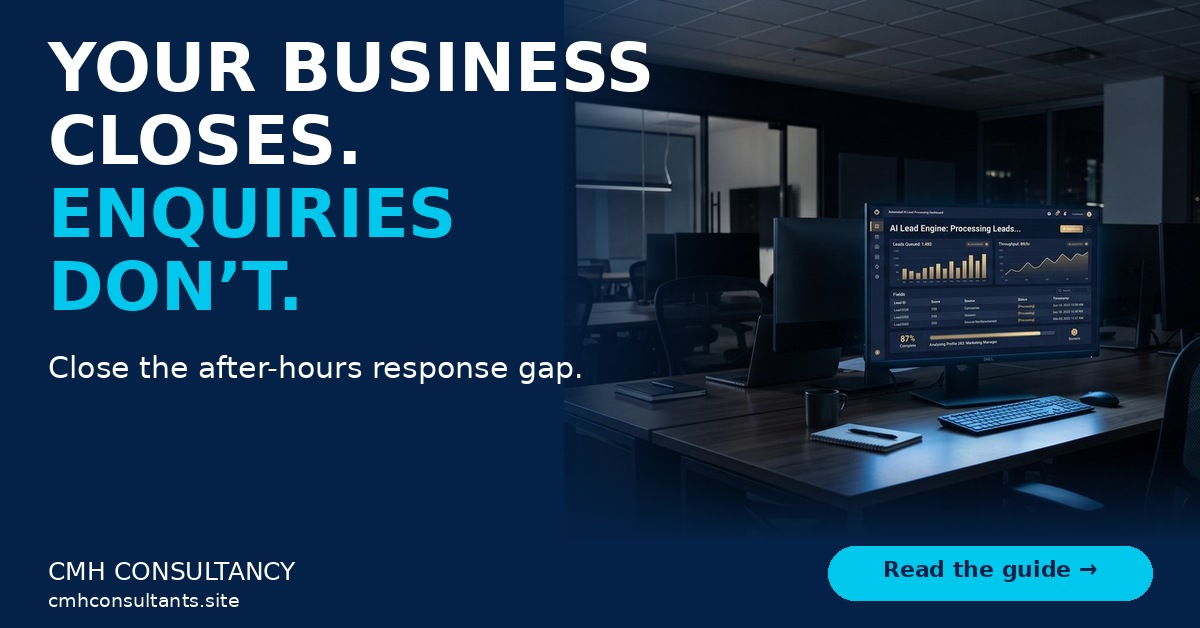
It’s 8:30 PM on a Thursday. Your business is closed. Your team went home hours ago. But somewhere in Trinidad — on a phone, on a laptop, probably lying in bed — a potential customer just typed your company name into Google, visited your website, filled out a contact form, or sent your business a WhatsApp message asking about your services.
What happens next determines whether you get that customer or your competitor does.
The Uncomfortable Truth About After-Hours Leads
Research consistently shows that between 30–45% of business enquiries are submitted outside of standard business hours. That’s nearly half your potential clients reaching out when nobody is there to respond.
Now factor in what we know about lead response time. Harvard Business Review research established that businesses responding within the first hour are seven times more likely to qualify leads than those that wait. A Forbes study found that leads reached within the first five minutes are 21 times more likely to convert than leads reached within 30 minutes.
Add these two statistics together: nearly half your leads come in after hours, and the business that responds fastest wins. If your team is asleep at 8:30 PM, you are mathematically behind before the business day even starts.
What Happens to Your After-Hours Leads Right Now?
In most businesses without automation, after-hours leads sit in an inbox or a WhatsApp chat until someone sees them the next morning. At 9:30 AM, someone finally responds — thirteen hours after the lead reached out.
During those thirteen hours, that same lead may have found another service provider through Google. They may have gotten a referral from a friend. They may have simply decided the timing was inconvenient and moved on. Or — and this is increasingly common — your competitor’s AI already responded, qualified the lead, and booked an appointment.
By the time your team replies, you’re not the first responder. You’re the backup option.
What After-Hours AI Coverage Looks Like
An AI automation system doesn’t sleep, take breaks, or need weekends. Here’s what happens with proper after-hours coverage:
8:31 PM — Lead submits a WhatsApp enquiry about your service. 8:31:45 PM — AI responds warmly, introduces your business, and asks two qualifying questions. 8:33 PM — Lead answers questions. 8:33:30 PM — AI provides relevant information, shares pricing overview, and offers to book a consultation. 8:37 PM — Lead selects an appointment slot for the following week. 8:37:30 PM — Automated confirmation sent. Lead added to CRM. Your team wakes up to a confirmed appointment in their calendar.
The lead never felt like they were talking to a bot. The experience felt fast, professional, and responsive. And you captured the appointment eight hours before your competitor even knew the lead existed.
The Competitive Advantage Is Real
The businesses in Trinidad and Tobago that invest in 24/7 AI coverage aren’t doing it because it’s fashionable. They’re doing it because it works — and because their competitors haven’t caught up yet. Right now, most businesses in this market are still running on 9-to-5 human responses.
That gap is an opportunity. The businesses that close it first will own significant market share before others realise what happened.
How Much Is Your After-Hours Gap Costing You?
Here’s a simple calculation. If your business generates $100,000 TTD per month in revenue and 35% of your leads come in after hours — assume you convert 10% of those leads through slow follow-up. A 24/7 AI system could push that conversion rate to 25–30%, capturing leads your current process loses entirely.
The revenue difference on those previously lost after-hours leads alone often pays for 6–12 months of automation investment.
CMH Consultancy builds 24/7 AI lead response and qualification systems for Trinidad and Tobago businesses. Stop losing half your leads to the clock. Call or WhatsApp us at +1 868 472 0763, or visit cmhconsultants.site to calculate your after-hours revenue gap.
Ready to Stop Losing Revenue?
Use our Revenue Recovery Calculator to see exactly how much you could recover — or book a free strategy call to discuss your specific situation.
Calculate My Recovery